
Physio-Chi - how is it relevant?
The History of Tai Chi Chuan
Exercising for health or self-defence has always been a traditional part of Chinese culture. Earliest exercises for health and strength dating back thousands of years recognised four factors which have together formed the basis of Chinese Medicine and exercise:
Man is a microcosmic reflection of Macrocosmic Law
All life is movement and change within Unity
The human organism is designed to function as an integrated whole
Prevention is better than cure.
These four factors are the premises upon which Traditional Chinese Medicine including acupuncture, herbal medicine, and therapeutic and callisthenic exercises such as Tai-chi Chuan and self defence techniques have been developed.
The relevance of an age old Martial Arts Tai Chi in today’s world is shown by the rise of awareness of Tai Chi’s health benefits. The observation that mind and body are intimately intertwined, the knowledge that the mind affects the body, make it obvious that anxiety creates body tension, and causes illness affecting breathing, circulation and bodily functioning. An active peaceful mind has long been recognised as necessary to health and a balanced personality as an efficient body.
Mental imagery and visualisations, using natural world animal and bird names of movements recreates the natural flow of the natural world.
Body movements combined with breathing achieves the controlling of the mind, emotion and body, initially for self defence as well as therapeutic value.
Physio-Chi is a modified Tai Chi form, in recent years modified Tai Chi forms have been shown in research to achieve improvements in a myriad of health outcomes.
Lets look at some research that shows the relevance of Physio-Chi as a modified Tai Chi form in our world today.
Journal of Cardiopulmonary Rehabilitation 2003 published Tai Chi as an Adjunct to cardiac rehabilitation exercise training. This recent research showing improvements in Cardiorespiratory function, balance and postural stability, falls prevention, and stress reduction. A review of the literature suggests benefits of Tai Chi exercise performed as an adjunct to cardiac rehabilitation exercise training, being cost effective and Tai Chi facilitates a lifestyle of health-related behaviour practices.
Aging Clinical & Experimental Research, 2006 published research on Neural Mechanisms underlying balance improvement with short term tai chi training. Results compared Tai Chi with the control group mobility exercises, (balance/awareness education and stress reduction). Both groups practiced for 1.5 hours 5 days/week for 3 weeks. The results showed the Tai Chi group but not the control group, significantly improved their ankle muscles response times and muscle activation, and significantly improved their balance measures. Tai Chi showed it significantly improves neuromuscular activation as a crucial response to trips or falls.
Frontiers in Sports & Active Living, 2025. Published in December 2025, Exploring the relationship between movement and breathing regulation in Tai Chi practice among middle aged and older men using a 3 dimensional respiratory-movement model shows a comparison between long term and beginner Tai Chi practitioners. This research looked at postural control and respiration being closely integrated processes vital for stability in older adults, and compared long term Tai Chi practitioners with beginner Tai Chi practitioners. The result showed long term Tai Chi practice enhances motor control through optimised diaphragmatic breathing, improved joint flexibility, and adaptive coordination between respiration and posture.
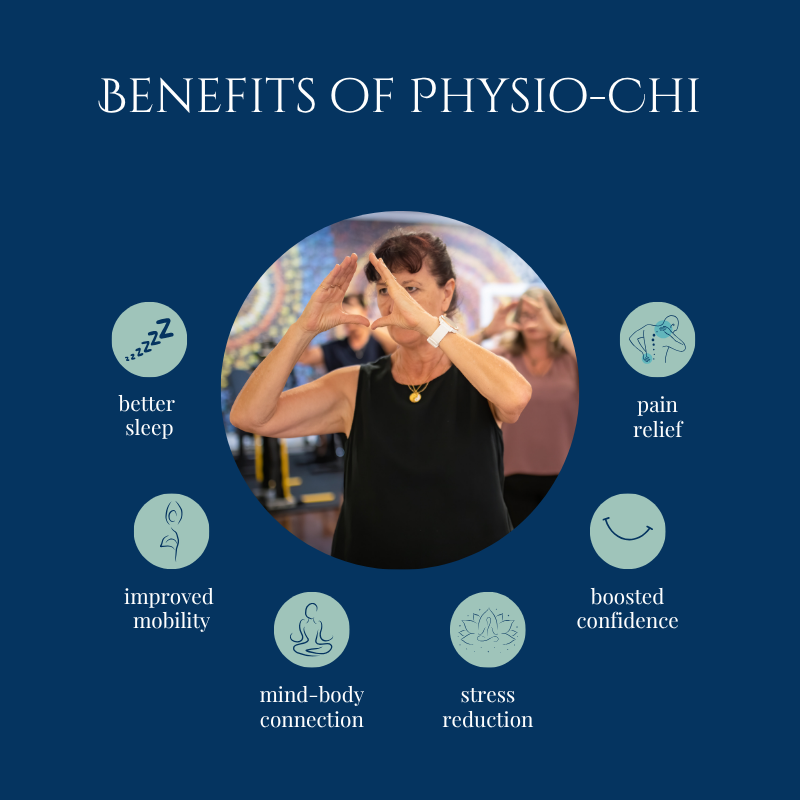
What the Evidence Confirms About Tai Chi
Regular practice of Tai Chi, between 1-5 times per week has been proven will significantly improve all of your health outcomes, reduce falls risk, improve breathing, posture, joint flexibility, and reduce stresses effects on our bodies. It is as relevant today as it has ever been.
Applying the Evidence: The Physio-Chi Approach
Physio-Chi has been developed by adapting traditional Tai Chi principles into a clear, accessible and evidence-informed format. Movements can be performed standing, seated or on a fit ball, making Physio-Chi suitable for people of all ages, abilities and mobility levels. This flexibility allows individuals to move safely and confidently while still gaining the full benefits of Tai Chi practice.
Physio-Chi has been designed as an online opportunity to integrate short or long Physio-Chi sessions into your day and week. There are 4 Qigong several minutes long, 10 minute mindfulness sessions, and varying lengths 20, 30, 40 minute Physio-Chi classes to both progress through and then be able to choose for variety.
Join our Physio-Chi community and enjoy the evidence based Physio-Chi form to achieve your health benefits for just $34.95 a month.
Unsure if Physio-Chi is right for you? Try our free guided practices below and see how it feels.
If you’re new to Tai Chi or Qigong, start here. Jenny introduces key terms and concepts used throughout Physio-Chi so you can move with confidence and deeper awareness.
In this warm and welcoming introduction, Jenny explains the meaning behind many of the phrases and movements you’ll hear in Physio-Chi sessions.
You’ll learn about the origins of Tai Chi and Qigong, how Physio-Chi blends their therapeutic principles, and what key terms such as Qi (Chi) and Dantian represent. Jenny also shares the inspiration behind traditional movement names like Painting Rainbows, White Rabbit, and Walking Among the Clouds and the Moon — imagery that connects body, mind, and nature to create a grounded, mindful state of movement.
No equipment is required — just an open mind and curiosity. This short video is the perfect place to begin before trying the free mini practices, helping you understand the language, energy concepts, and intentions behind each flow.
✨ Next, explore “Five Element Qi Gong” or “Flowering Lotus” to put these ideas into practice.